Axis of rotation is an imaginary straight line about which an object rotates or spins. Every point on the object moves in a circular path centered on this line, except for points that lie directly on the axis itself, which do not move sideways because they are part of the line of rotation. The axis of rotation provides the reference direction for describing rotational motion and is one of the most fundamental concepts in geometry, physics, astronomy, and mechanical engineering. It defines the orientation of rotational motion but does not, by itself, specify how fast the object rotates.
 In geometry, an axis of rotation is used to describe the generation of three-dimensional solids by rotating a two-dimensional figure around a fixed line.
In classical mechanics, the axis of rotation is the line about which a rigid body undergoes rotational motion. Every point on the body moves along a circular path whose radius is the perpendicular distance from that point to the axis. Points farther from the axis travel greater distances during each revolution and therefore have higher linear (tangential) speeds, even though all points on the rigid body share the same angular velocity.
The axis of rotation may pass through the object or lie outside it. When the axis passes through the object, the object spins about its own center or another internal line. When the axis lies outside the object, the object revolves around an external line. In engineering and physics, the distinction between rotation about an internal axis and motion about an external axis is important because it affects the calculation of torque, moment of inertia, angular momentum, and kinetic energy.
The orientation of the axis of rotation may remain fixed or change over time. A stationary electric motor typically rotates about a fixed axis maintained by bearings that constrain the shaft. In contrast, spinning objects such as gyroscopes, tops, or planets may experience changes in the direction of their rotational axis due to external torques.
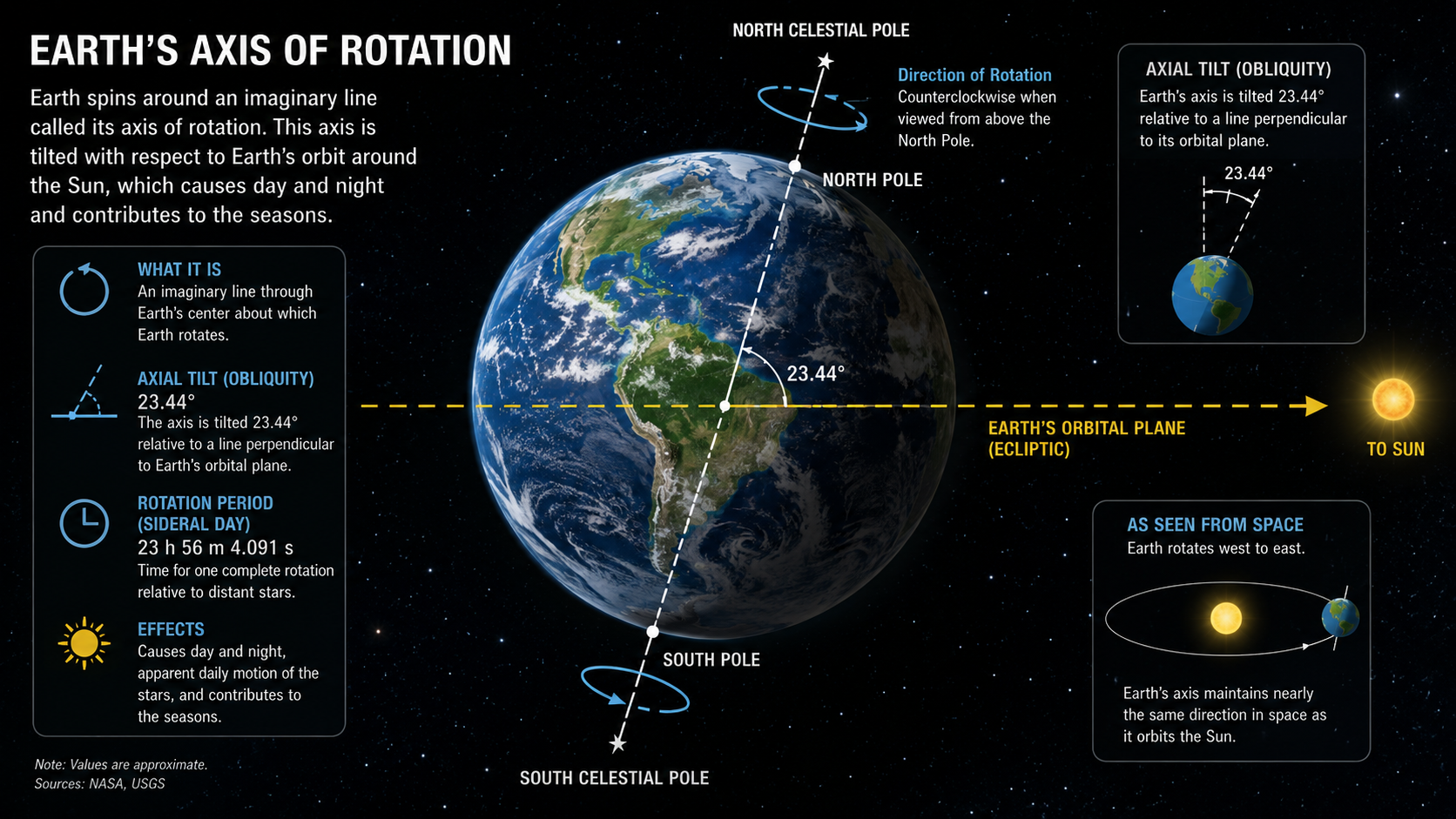
In astronomy, the axis of rotation is especially significant because it determines how celestial bodies spin in space. Earth rotates once approximately every sidereal day about an axis that passes through the geographic North and South Poles. This rotational axis is tilted by about 23.4 degrees relative to the plane of Earth's orbit around the Sun, a property known as Earth's axial tilt. The tilt is responsible for the changing seasons because it alters the angle at which sunlight reaches different parts of Earth's surface throughout the year. Other planets, moons, stars, and many asteroids also possess axes of rotation, each with its own orientation and rotational period.
The axis of rotation is closely related to several important physical quantities. The moment of inertia depends on how mass is distributed relative to the chosen axis, meaning the same object can have different moments of inertia depending on which axis is considered. Torque causes an object to begin rotating or changes its rotational motion about an axis. Angular momentum is directed along the axis of rotation according to the right-hand rule, providing both the magnitude and direction of the rotational motion.
From a mathematical perspective, an axis of rotation can be represented as a line in two-dimensional or three-dimensional coordinate systems. In three-dimensional space, it is commonly defined by a point through which the axis passes and a direction vector. Rotations about arbitrary axes are described using rotation matrices, quaternions, or axis-angle representations, all of which are standard mathematical tools in computer graphics, robotics, aerospace guidance, and rigid body mechanics.
It is important to distinguish the axis of rotation from the center of rotation. The center of rotation is a single point about which an object rotates in a plane, whereas the axis of rotation is an entire line extending through space. In three-dimensional rotational motion, every axis contains infinitely many points, while each point along that line serves as a center of rotation for the circular motion occurring in planes perpendicular to the axis.