Power Output of a Dam Formula |
||
|
\( P \;=\; \eta \cdot \rho \cdot g \cdot h \cdot Q \) (Power Output of a Dam) \( \eta \;=\; \dfrac{ P }{ \rho \cdot g \cdot h \cdot Q }\) \( \rho \;=\; \dfrac{ P }{ \eta \cdot g \cdot h \cdot Q }\) \( g \;=\; \dfrac{ P }{ \eta \cdot \rho \cdot h \cdot Q }\) \( h \;=\; \dfrac{ P }{ \eta \cdot \rho \cdot g \cdot Q }\) \( Q \;=\; \dfrac{ P }{ \eta \cdot \rho \cdot g \cdot h }\) |
||
| Symbol | English | Metric |
| \( P \) = Power Output | \( W \) | \( W \) |
| \( \eta \) (Greek symbol eta) = Turbine Efficency | \( dimensionless \) | \( dimensionless \) |
| \( \rho \) (Greek symbol rho) = Water Density | \(lbm\;/\;ft^3\) | \(kg\;/\;m^3\) |
| \( g \) = Gravitational Acceleration | \(ft\;/\;sec^2\) | \(m\;/\;s^2\) |
| \( h \) = Head (Usable Water Fall Height) | \(ft\) | \(m\) |
| \( Q \) = Discharge Flow Rate | \(ft^3 \;/\; sec\) | \(m^3 \;/\; s\) |
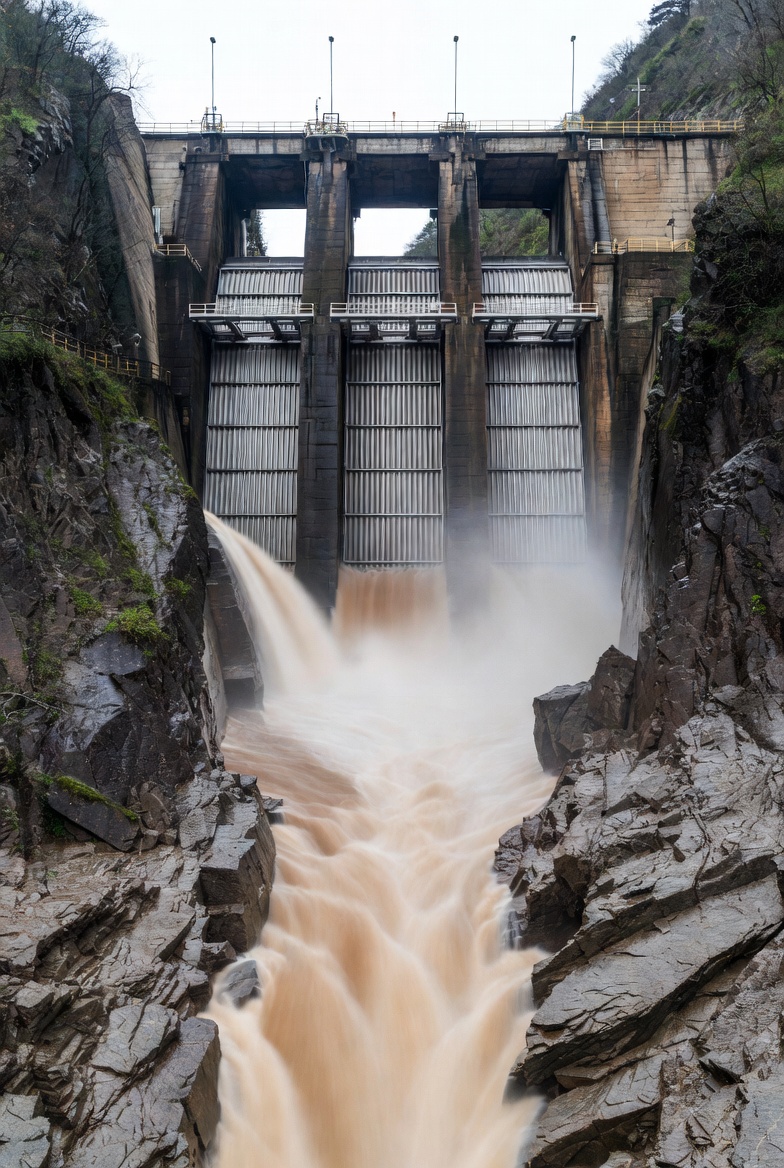
Power output of a dam is the amount of electrical power that a hydroelectric dam can generate from the energy of moving or falling water. This power comes from converting the gravitational potential energy of water stored at a height (called the head) into mechanical energy as the water flows through turbines, which then drive generators to produce electricity. The power output depends mainly on the water flow rate, the height difference between the reservoir and the turbine, the density of water, the acceleration due to gravity, and the overall efficiency of the turbine generator system. In general, dams with higher water flow and greater head can produce more power, making hydroelectric dams an important source of renewable energy.