Volume of void, abbreviated as \(V_v\), also called void ratio, is the volume of open spaces or pores within a soil sample. This parameter is used in geotechnical engineering and soil mechanics because it helps determine the soil's porosity, permeability, and compressibility.
Volume of Void Formula |
||
|
\( V_v \;=\; V_t - V_s \) (Volume of Voids) \( V_t \;=\; V_v + V_s \) \( V_s \;=\; V_t - V_v \) |
||
| Symbol | English | Metric |
| \( V_v \) = Volume of Void | \(ft^3\) | \(m^3\) |
| \( V_t \) = Total Volume of Soil | \(ft^3\) | \(m^3\) |
| \( V_s \) = Volume of Solid Soil | \(ft^3\) | \(m^3\) |
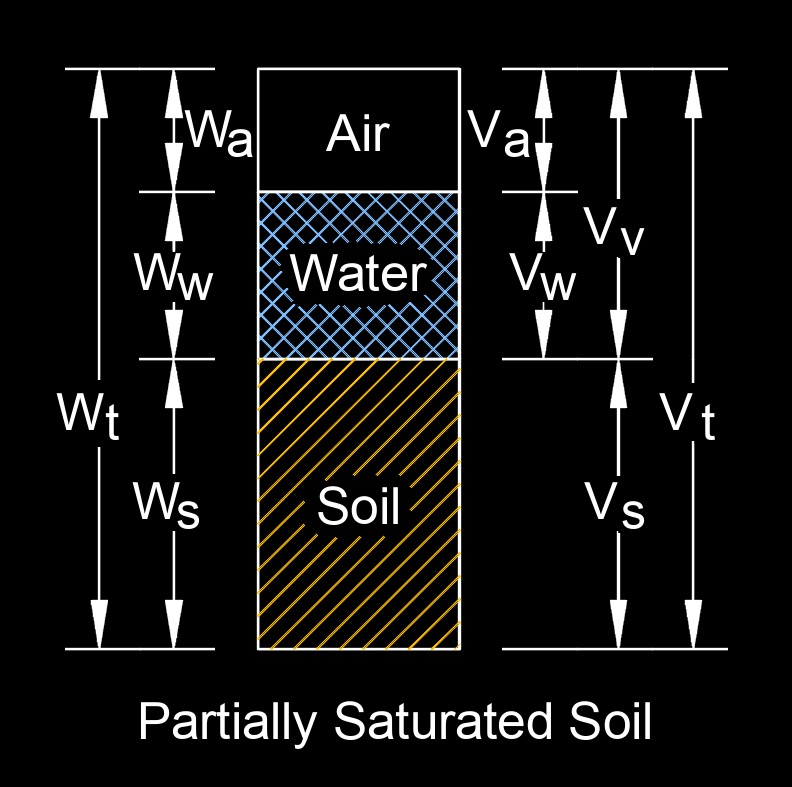
Understanding the void ratio of soil is essential for various engineering and construction applications. It can impact the soil's ability to retain and transmit water, its compressibility under load, and its overall stability. Different types of soil (sand, clay, silt, etc.) will have different void ratios, and these properties play a significant role in the design of foundations, retaining walls, and other civil engineering projects.