Liquidity Index, abbreviated as \(LI\) or \(IL\), a dimensionless number, is a concept in soil mechanics, particularly in the classification and evaluation of fine-grained soils such as silts and clays. It is a dimensionless parameter that quantifies the natural consistency or relative firmness of a soil in relation to its Atterberg limits.
Liquidity Index formula |
||
|
\( LI \;=\; \dfrac{ w - PL }{ LL - PL } \) \( LI \;=\; \dfrac{ w - PL }{ PI } \) |
||
| Symbol | English | Metric |
| \( LI \) = Liquidity Index | \(dimensionless\) | \(dimensionless\) |
| \( w \) = Natural Water Content | \(dimensionless\) | \(dimensionless\) |
| \( PL \) = Plastic Limit | \(dimensionless\) | \(dimensionless\) |
| \( LL \) = Liquid Limit | \(dimensionless\) | \(dimensionless\) |
| \( PI \) = Plasticity Index | \(dimensionless\) | \(dimensionless\) |
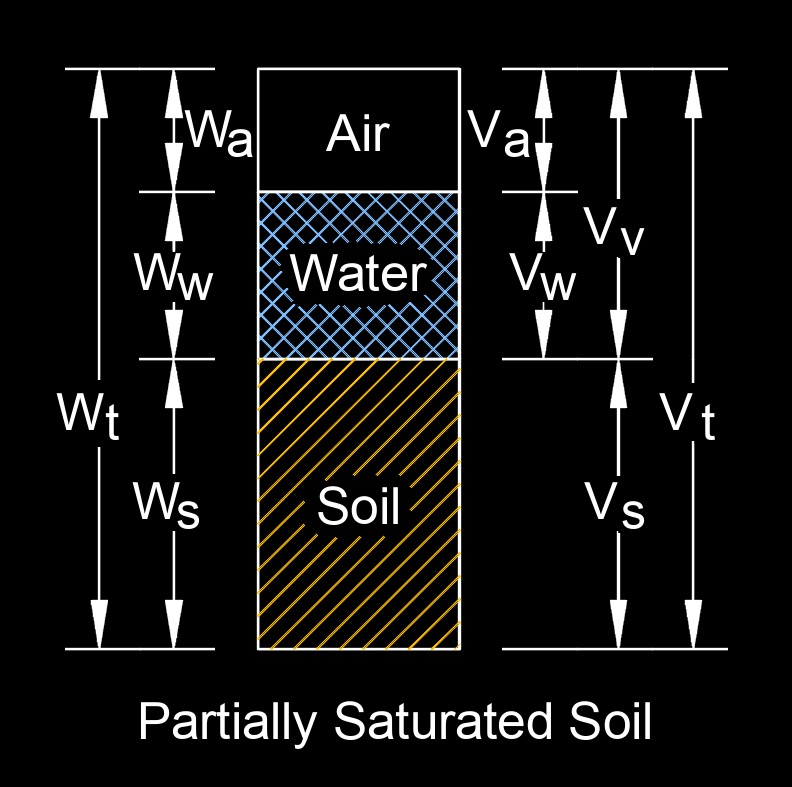
The \(LI\) expresses where the natural water content of the soil lies within this plastic range. A liquidity index of \(0\) indicates that the soil’s water content is exactly at its plastic limit, meaning the soil is at the threshold between semi-solid and plastic states. A Liquidity Index of \(1\) indicates that the soil’s water content equals its liquid limit, meaning it is at the boundary between plastic and liquid behavior. Values of \(LI\) greater than \(1\) indicate the soil is wetter than its liquid limit and behaves as a very soft or liquid-like material, whereas values below \(0\) indicate a drier, semi-solid, or brittle soil.
The liquidity index is useful in geotechnical engineering because it provides insight into soil consistency, workability, and shear strength. Engineers use \(LI\) to assess the suitability of soils for construction, predict settlement behavior, and estimate the ease of compaction. Its value also helps in correlating soil properties with field behavior; for instance, clays with high liquidity index tend to have lower shear strength and higher compressibility, which can impact foundation design and slope stability.