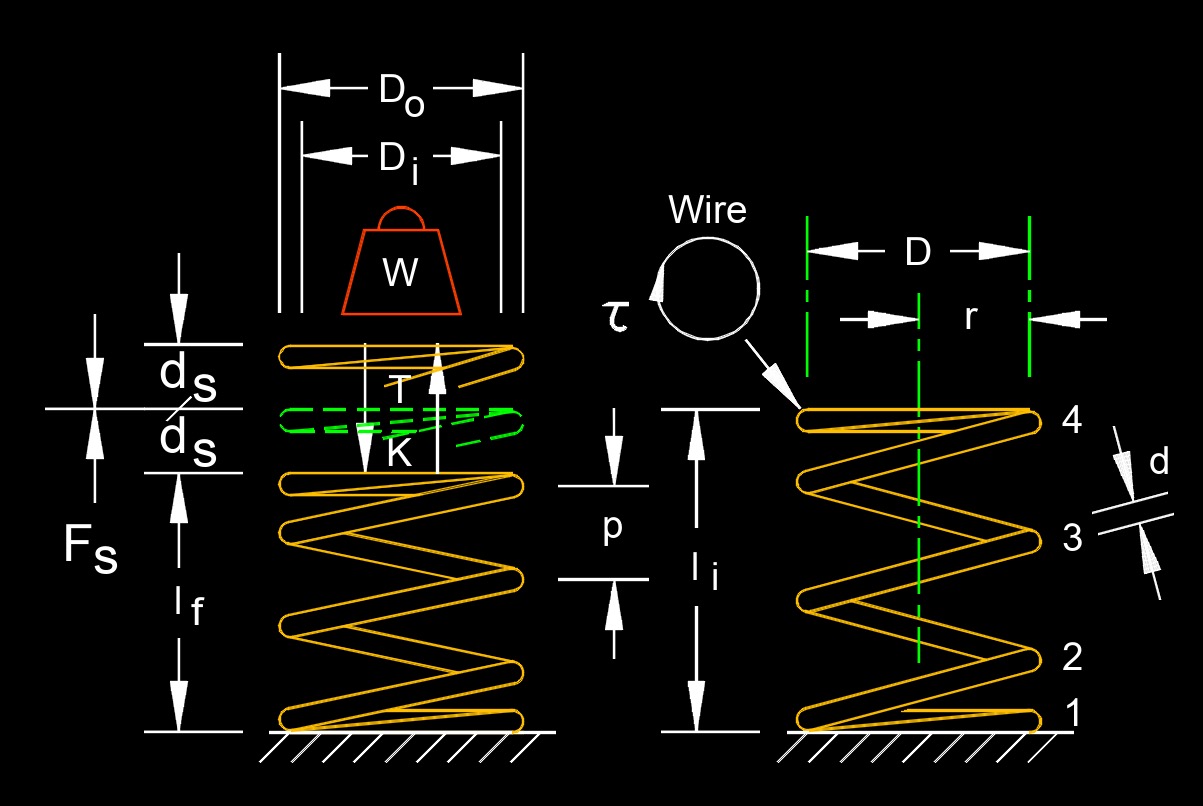
Spring rate, abbreviated as \(k\), is not the same as spring load. The spring rate is based on the spring's working load. Spring rate is the rate of force or weight required to travel one unit of measurement. The lower the spring rate, the softer the spring. The softer the spring, the smother the ride. Spring load is the amount of weight a spring is designed to carry when compressed to a certain height.
Spring Rate Formula |
||
|
\( k \;=\; \dfrac{ F_a }{ \delta }\) (Spring Rate) \( F_a \;=\; k \cdot \delta \) \( \delta \;=\; \dfrac{ F_a }{ k }\) |
||
| Symbol | English | Metric |
| \( k \) = Spring Rate | \(lbf\;/\;in\) | \(kg\;/\;mm\) |
| \( F_a \) = Axial Longitudinal Applied Force | \( lbf \) | \( kg \) |
| \( \delta \) = Displacement Produced by the Force | \( in \) | \(mm \) |