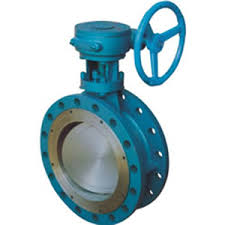
Butterfly valve, abbreviated as \(BTFLV\), is a quarter turn valve (90° or less) with a circular disk as its closing element. The standard design has the valve stem running through the disk, giving a symmetrical appearance. Other designs offset the stem. Advantages include less wear and tear on the disk and seats, and tighter shut-off capabilities. When space is limited, sometimes larger valves may use a hand wheel with a gear arrangement. Butterfly valves are rather easy to maintain. These valves are used for gases, liquids, slurries, powders, and vacuum.
Butterfly Valve DatasheetsFace to face dimensions for full and standard port valves is the same. All ball valves 2" and below are both standard and full port valves. | |||
|---|---|---|---|
| Butterfly Type | Datasheets | Butterfly Type | Datasheets |
   |
|
 |
|
There are Two Butterfly Valve Categories
Category A - Manufacturer's rated cold working pressure (CWP) butterfly valves, usually with a concentric disc and seat configuration. Sizes covered are NPS 2 to NPS 48 for valves having ASME Class 125 or Class 150 flange bolting patterns.
Category B - Pressure-temperature rated butterfly valves that have an offset seat and either an eccentric or a concentric disc configuration. These valves may have a seat rating less than the body rating. Sizes covered are NPS 3 to NPS 24 for Classes 150, 300, and 600.
Butterfly Valve Design Classification
Double Offset Butterfly Valve - This valve features the stem center deviated from the center of the disc and valve. With this structure, the valve disc can leave the valve seat quickly, greatly reducing unnecessary over compression and scraping between them. This structure also helps decrease the wearing process and prolongs the operational life of the valve.
Fire Tight Valve - When using valves in a service that may provide fuel to a fire, it is important to ensure that they are fire tight. Typically the seat in a soft seated fire tight valve contains a metal strip that will provide additional sealing should the seat be burnt or melted away. Fire tight valves can be found on fuel gas applications, VRU systems and in other flammable systems.
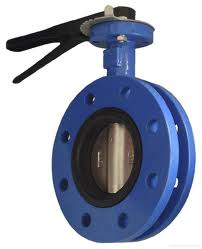
Flange Style Butterfly Valve - A butterfly valve with a flange on each end. These have a larger face to face dimension than the wafer and lug style butterfly valves and should not be used when there is limited space. These valves connect directly to the flanges by means of machine bolt to each side of the valve. If the valve torque is high or valve operations become too frequen, a manual flanged butterfly valves can be automated if need be.
High Performance Butterfly Valve - A valve in which the stem is not collinear to the disc centerline but rather offset from the center. The use of offset design helps to enhance uniform tight shut-off against the valve seat and also reduce wear due to friction. This valve can be used for shut-off and throttling fluid flow applications. This valve is made to handle different fluids from general fluid flow applications to viscous and corrosive fluids. The corrosive fluids can be gases or steam. High-performance butterfly valves are mostly of large sizes like 60 inch diameter.
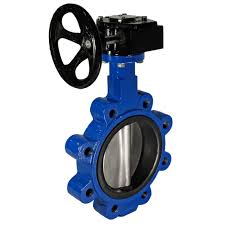
Lug Style Butterfly Valve - Lug butterfly valves connect directly to the flanges by means of a lug or machine bolt. Since these are attached directly to the flanges, each length of pipe on either side of hte valve can be removed and replaced independant of the other. Unlike a wafer type butterfly valve, a lug style valve can serve as an end of the line valve. Lug style butterfly valves have the same face to face dimensions as a wafer style butterfly valve. The valves can be used for end of line service but a blind flange is always recommended. The valves are manufactured to be compatible with either pneumatic or electric actuation.
Triple Offset Butterfly Valve - The design eliminates the rubbing between the seat and seal ring through the flow path, reducing seat and seal wear and extending cycle life. They are used in applications similar to gate valves, where a metal seat is required, and tight shutoff and/or quarter-turn actuation is desired. Triple offset butterfly valves can open and close more quickly and can be frequently operated, even if there is an emergency shutoff. This valve has low torque and is recommended for both high and low temperature applications.
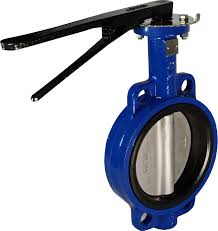
Wafer Style Butterfly Valve - Most wafer style butterfly valves are engineered with four holes that align with the connected pipeline. The valve is sandwiched between two flanges. The rubber valve seat creates a strong seal between the valve and flange connection. Unlike lug style butterfly valves, wafer style butterfly valves cannot be used as pipe ends or end of line service. The entire line must be shut down if either side of the valve requires maintenance. Wafer style butterfly valves are manufactured to be compatible with either pneumatic or electric actuation. Disc and seat material should be determined based on application and flow media.
Zero Offset Butterfly Valve - Concentric or rubber seated are other names for the zero-offset design. Zero offset means there is no offset by the stem of the valve. The valve seals via interference along the disc edge at the stem between the disc and the rubber seat.
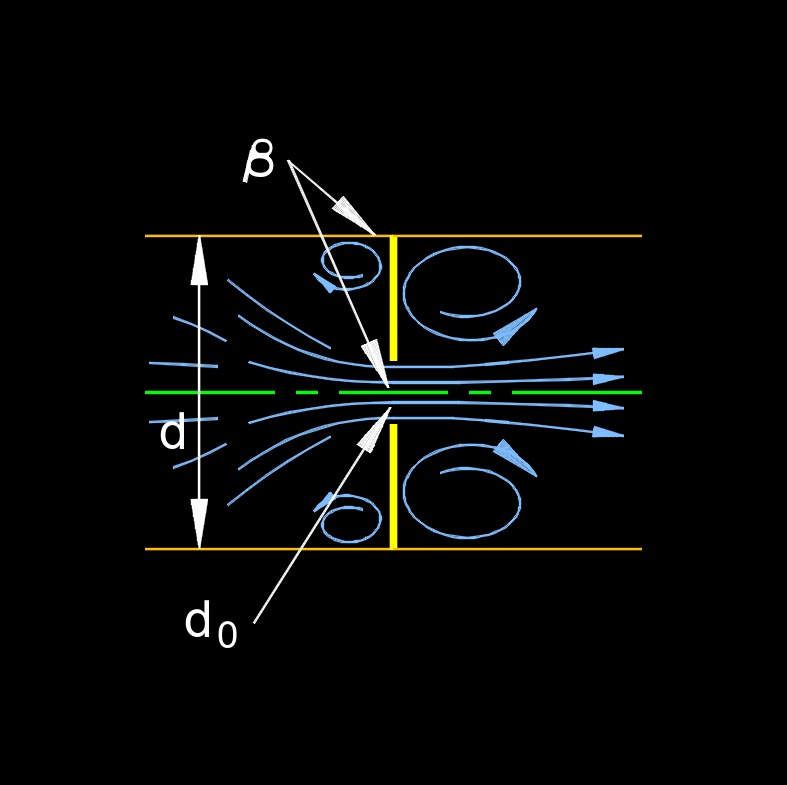
Optical path length, abbreviated as \(OPL\), is the effective distance that light travels through an optical system after accounting for the optical properties of the materials along its path. Unlike ordinary geometric distance, which measures only the physical length between two points, optical path length also includes the effect of the material's refractive index, which determines how much the material slows the propagation of light. Optical path length is used in wave optics, fiber optics, astronomy, and optical engineering because it determines how the phase of light changes as it propagates through different media. \( OPL \;=\; n \cdot d \) (Optical Path Length) \( n \;=\; \dfrac{ OPL }{ d }\) \( d \;=\; \dfrac{ OPL }{ n }\) Unified Soil Classification System (USCS) is a widely used engineering classification system for soils based on particle size distribution (gradation) and plasticity characteristics (Atterberg limits). The purpose of USCS is to classify soils (primarily mineral and organo-mineral soils) into categories for engineering purposes using results from prescribed laboratory tests: sieve analysis for grain size and Atterberg limits for plasticity. It assigns a two-letter symbol (and often a group name) to describe the soil's texture, grain size, gradation, and plasticity behavior. It provides a standardized, consistent way to communicate soil properties relevant to engineering behavior (e.g., strength, permeability, compressibility, workability). This facilitates design, construction, and analysis in geotechnical engineering by grouping soils with similar expected performance. USCS uses a two-letter symbol: First letter (primary) - Indicates the major soil constituent or group. Second letter (secondary/descriptive): Refines the classification based on gradation (for coarse-grained) or plasticity (for fine-grained). Applications Limitations Orifice plate beta ratio, abbreviated as \( \beta \) (Greek symbol beta), also called beta value or beta coefficient, a dimensionless number, is the relative size of the orifice opening compared to the pipe diameter in which it is installed. The beta ratio is important in flow measurement applications using orifice plates because it affects the accuracy and performance of the measurement. The beta ratio determines the shape of the flow profile downstream of the orifice plate and influences factors such as pressure drop and flow coefficient. \( \beta \;=\; \dfrac{ d_o }{ d }\) (Orifice Plate Beta Ratio) \( d_o \;=\; \beta \cdot d \) \( d \;=\; \dfrac{ d_o }{ \beta }\) Typically, orifice plate installations aim for a beta ratio between 0.2 and 0.8. A beta ratio of 0.2 means that the orifice diameter is 20% of the pipe diameter, while a beta ratio of 0.8 indicates that the orifice diameter is 80% of the pipe diameter. Choosing an appropriate beta ratio depends on factors such as the desired measurement accuracy, the flow conditions, and the specific application requirements. It's worth noting that different beta ratios may require different correction factors and equations to accurately calculate the flow rate through the orifice. These correction factors take into account the beta ratio and other parameters to provide more precise measurements.
Millimeter per Square Second
Millimeter per Square Second Conversion Table Multiply By To Get
0.1
centimeter per square second
0.003278551
foot per square second
0.0001019
acceleration of gravity, g
0.0010
meter per square second
0.00223537
mile per hour second
1
millimeter per square second
Optical Path Length
Optical Path Length Formula
Symbol
English
Metric
\( c \) = Optical Path Length
\(ft\)
\(m\)
\( n \) = Refraction Index
\(dimensionless\)
\(dimensionless\)
\( d \) =Geometric (Physical) Path Length
\(ft\)
\(m\)
Unified Soil Classification System
Standards
Primary and Secondary Letters
G - Gravel (coarse-grained, >50% of coarse fraction retained on No. 4 sieve)
S - Sand (coarse-grained, >50% of coarse fraction passes No. 4 sieve)
M - Silt (fine-grained)
C - Clay (fine-grained)
O - Organic (organic silt or clay)
PT - Peat (highly organic)
For coarse-grained (G or S)
W - Well-graded (wide range of particle sizes, good distribution)
P - Poorly graded (uniform particle sizes or gap-graded)
M - Silty fines
C - Clayey fines
For fine-grained (M or C)
L - Low plasticity (lean, liquid limit < 50%)
H - High plasticity (fat, liquid limit ≥ 50%)Common Applications and Limitations
Geotechnical engineering for foundations, embankments, pavements, earth dams, and site characterization.
Civil engineering projects involving soil as construction material or foundation support.
Used alongside field descriptions and other tests for soil logging and reporting (e.g., in borings/logs).
Primarily laboratory-based (requires sieve analysis and Atterberg limits); not ideal for all field conditions or highly variable soils without testing.
Focuses on engineering behavior but may need supplementation for specific applications (e.g., environmental, agricultural, or detailed mineralogy).
Does not address all safety or site-specific factors; professional judgment is required.
Organic soils and highly variable deposits may need special consideration or additional classification systems.
Orifice Plate Beta Ratio
Orifice Plate Beta Ratio formula
Symbol
English
Metric
\( \beta \) (Greek symbol beta) = Orifice Plate Beta Ratio
\(dimensionless\)
\(dimensionless\)
\( d_o \) = Orifice Opening Diameter
\(in\)
\(mm\)
\( d \) = Pipe Inside Diameter
\(in\)
\(mm\)
Butterfly Valve Advantages and Disadvantages | |
|---|---|
| Advantages | Disadvantages |
|
|