
Hazen-Williams flow rate is a widely used empirical formula for calculating the flow of water in a pipe. It is commonly used in civil engineering and hydraulics for estimating the flow rate of water in a pipeline based on the characteristics of the pipe and the properties of the water. The formula is particularly suited for water flow in municipal water supply and distribution systems.
Hazen-Williams Flow Rate Formula |
||
|
\( Q \;=\; C \cdot 0.285 \cdot d^{2.63} \cdot m^{0.54} \) (Hazen-Williams Flow Rate) \( C \;=\; \dfrac{ Q }{ 0.285 \cdot d^{2.63} \cdot m^{0.54} }\) \( d \;=\; \left( \dfrac{ Q }{ C \cdot 0.285 \cdot m^{0.54} } \right) ^{1/2.63} \) \( m \;=\; \left( \dfrac{ Q }{ C \cdot 0.285 \cdot d^{2.63} } \right) ^{1/0.54} \) |
||
| Symbol | English | Metric |
| \( Q \) = Flow Rate | \(ft^3 \;/\;sec\) | - |
| \( C \) = Hazen-Williams Coefficient | \( dimensionless \) | - |
| \( d \) = Pipe Inside Diameter | \( in \) | - |
| \( m \) = Hydraulic Grade Line Slope | \( dimensionless \) | - |
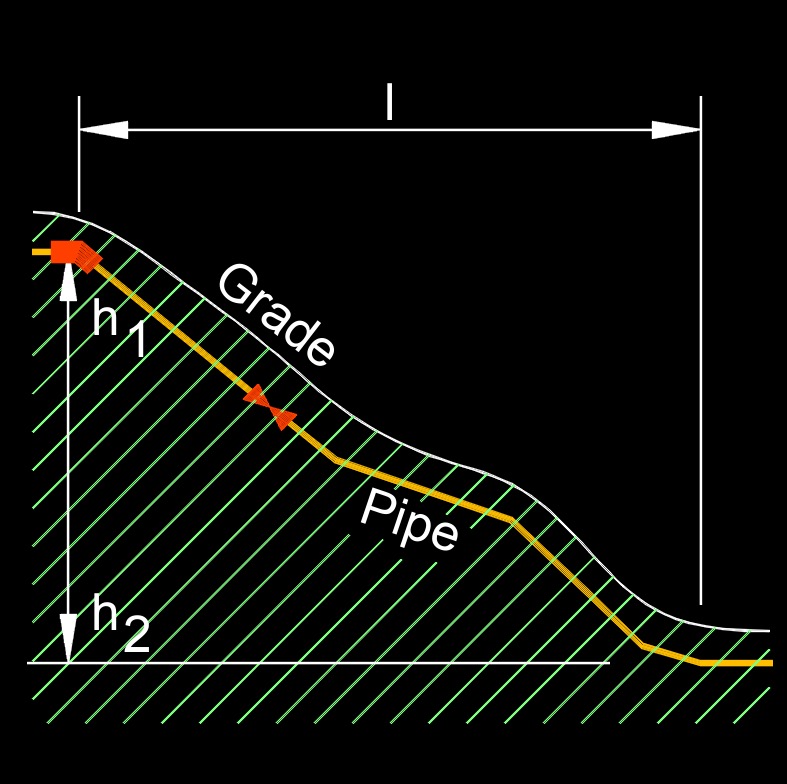
The Hazen-Williams equation simplifies the calculation of flow rates compared to more complex methods like the Darcy-Weisbach equation. However, it is important to note that the Hazen-Williams equation is an empirical formula and may not be as accurate as more rigorous methods, especially for systems with high velocities or non-standard conditions. It is commonly used for water supply systems where simplicity and ease of use are more critical than precision.