
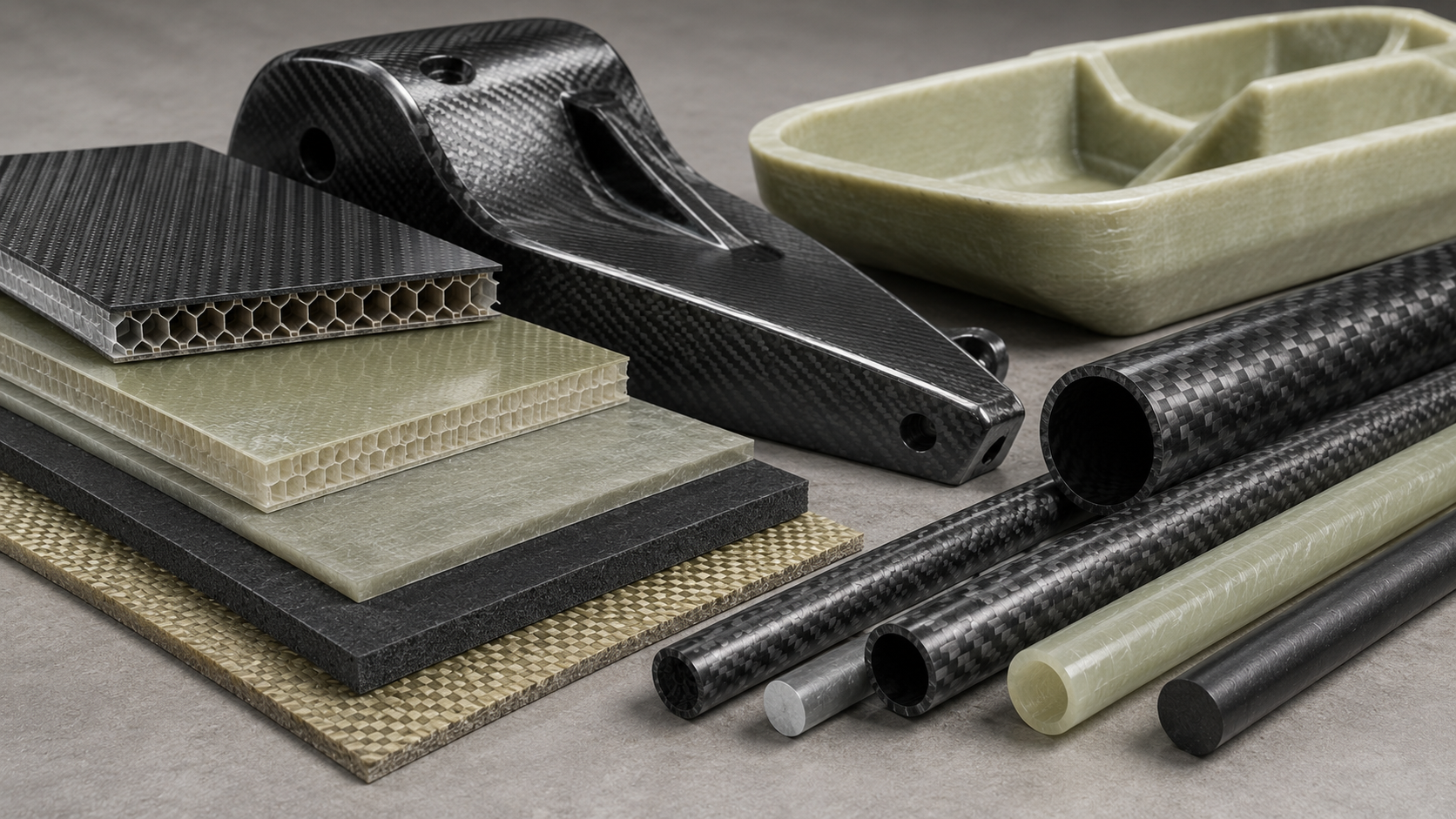
 Composite is a material formed by combining two or more distinct materials that remain physically separate and identifiable within the finished product. The purpose of creating a composite is to obtain a combination of properties that cannot usually be achieved by any of the individual constituent materials alone. In most engineered composites, one component serves as the matrix, which binds the material together and transfers loads, while the other component serves as the reinforcement, which provides strength, stiffness, toughness, or other desired properties.
Basic Components of a Composite Material
Composite Types
Composites (or composite materials) are engineered materials made from two or more constituent materials with significantly different physical or chemical properties that remain distinct in the finished structure, producing a material with superior characteristics.
Polymer Matrix Composites (PMCs) - The most common type; consist of a polymer (thermoset or thermoplastic) matrix reinforced with fibers (e.g., glass, carbon, aramid) or particles; widely used in aerospace, automotive, and consumer goods for their light weight and strength.
Metal Matrix Composites (MMCs) - Feature a metal matrix (e.g., aluminum, titanium, magnesium) reinforced with ceramic particles, fibers, or whiskers; valued for improved strength, stiffness, and wear resistance at higher temperatures.
Ceramic Matrix Composites (CMCs) - Composed of a ceramic matrix reinforced with ceramic fibers or particles; offer high-temperature stability, oxidation resistance, and toughness for extreme environments like engines and aerospace.
Classification by Reinforcement
Fiber-reinforced Composites - Continuous or discontinuous fibers as reinforcement.
Particle-reinforced Composites - Particles or whiskers dispersed in the matrix.
Structural Composites - Include laminates and sandwich structures.
Other recognized categories include carbon-carbon composites and hybrid composites, but the matrix-based classification (PMC, MMC, CMC) is the most standard and verifiable primary system.
Benefits of composite materials include high strength-to-weight ratio, corrosion resistance, and tailored properties. Applications are diverse, ranging from aerospace and automotive components to sports equipment, construction materials, and more. However, challenges include production complexity, cost, and sometimes difficulty in recycling, depending on the specific composite materials used. The selection of a composite material depends on the desired properties for a particular application.