Total solar eclipse is a celestial event that occurs when the Moon passes directly between the Sun and Earth, completely obscuring the Sun's bright disk from the perspective of observers on Earth. This alignment happens because the three bodies, the Sun, Moon, and Earth, must be in syzygy (pronounced SIZ-uh-jee), or nearly perfectly lined up in space, with the Moon positioned such that its apparent size in the sky matches or exceeds that of the Sun. For this to result in a total eclipse rather than a partial or annular one, the observer must be located within the narrow path of the Moon's umbra, the darkest central part of its shadow cast onto Earth's surface.
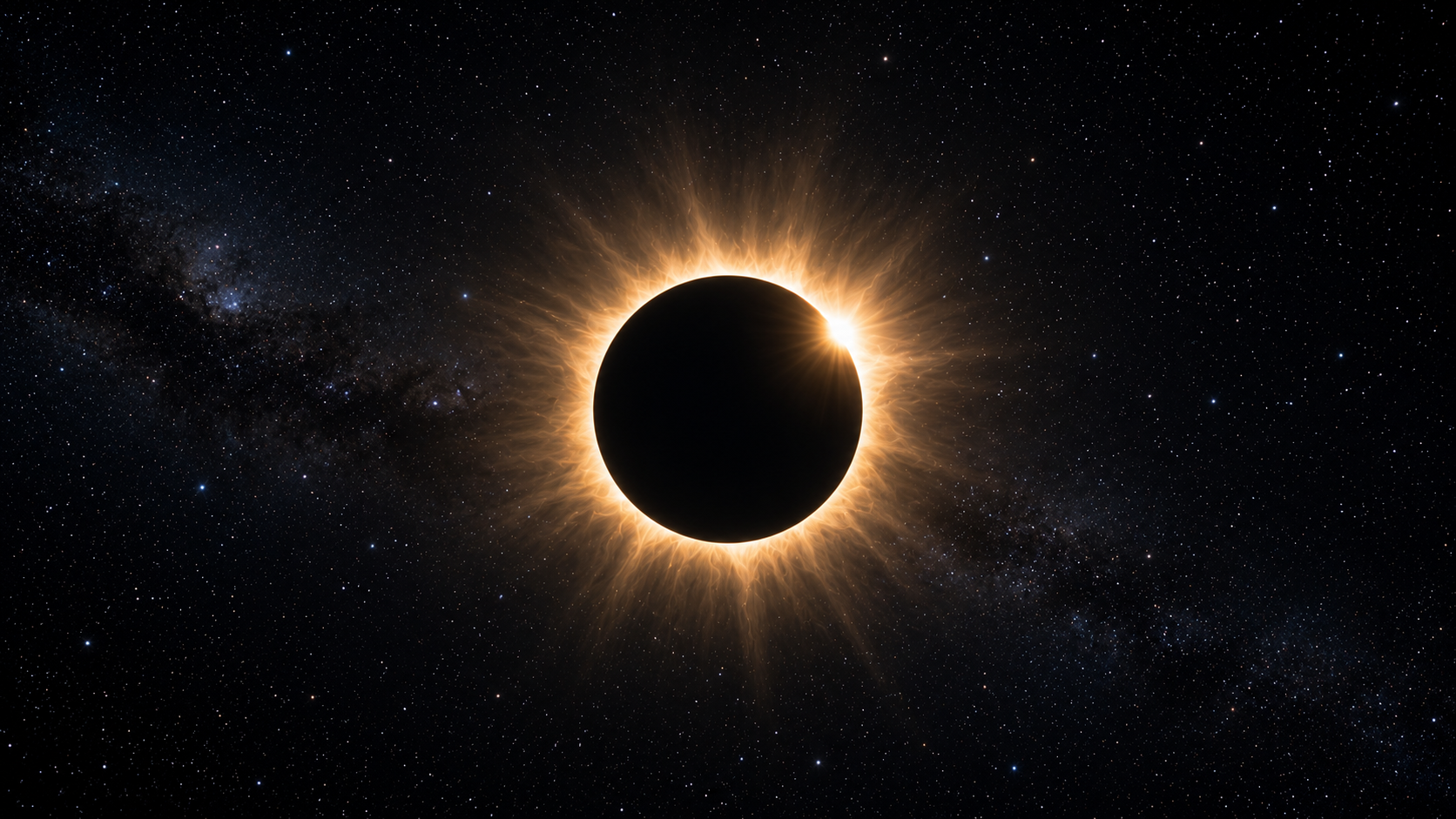 During the progression of a total solar eclipse, the event unfolds over a period of several hours. It begins with a partial phase as the Moon starts to overlap the Sun's disk, gradually reducing the amount of visible sunlight. As the Moon continues its motion, it covers more of the Sun until the moment of totality, when the Sun is fully blocked. At this point, the sky darkens significantly, resembling twilight or night, and the Sun's faint outer atmosphere, known as the corona, becomes visible to the naked eye for a brief duration, typically lasting from a few seconds to several minutes, depending on the specific geometry of the alignment.
The path of totality on Earth's surface is relatively narrow, often only about 100 to 200 kilometers wide, while a much larger surrounding area experiences only a partial eclipse, where the Moon covers only part of the Sun. Total solar eclipses occur on average every 18 months somewhere on Earth, but any given location on the planet may experience one only once every several centuries due to the specific orbital mechanics involved. The phenomenon is possible because of the coincidental near-match in the apparent angular diameters of the Sun and Moon as seen from Earth, which allows the Moon to fully cover the Sun under the right conditions.
Safety precautions are essential during a total solar eclipse, as viewing any part of the Sun's photosphere without proper protection can cause permanent eye damage. Special eclipse glasses or filters must be used during all phases except the brief period of totality, when the Sun's bright surface is completely hidden. This event provides a unique opportunity for scientific observation of the solar corona and other phenomena that are otherwise difficult to study.