
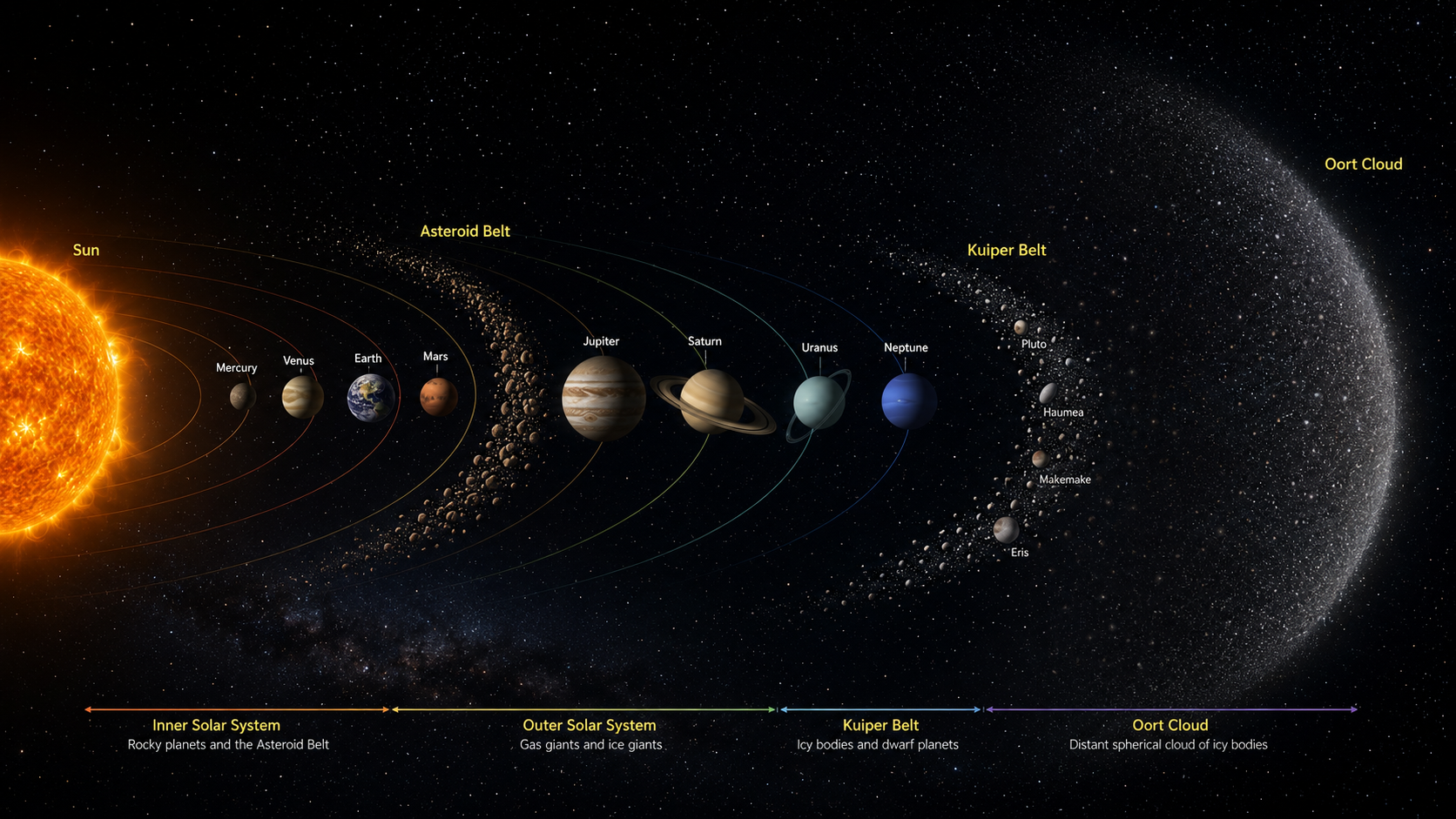
Mars is the fourth planet from the Sun and is one of the eight major planets in the Solar System. It is classified as a terrestrial planet, meaning that it has a solid, rocky surface similar in general composition to those of Mercury, Venus, and Earth. Mars has a mean diameter of approximately 6,779 kilometers (4,212 miles), making it about half the diameter of Earth. Its mass is about 10.7% that of Earth, and its surface gravity is about 38% of Earth's gravity. Mars orbits the Sun at an average distance of about 227.9 million kilometers (141.6 million miles) and completes one orbit in approximately 687 Earth days. A Martian day, known as a sol, lasts about 24 hours and 39 minutes.
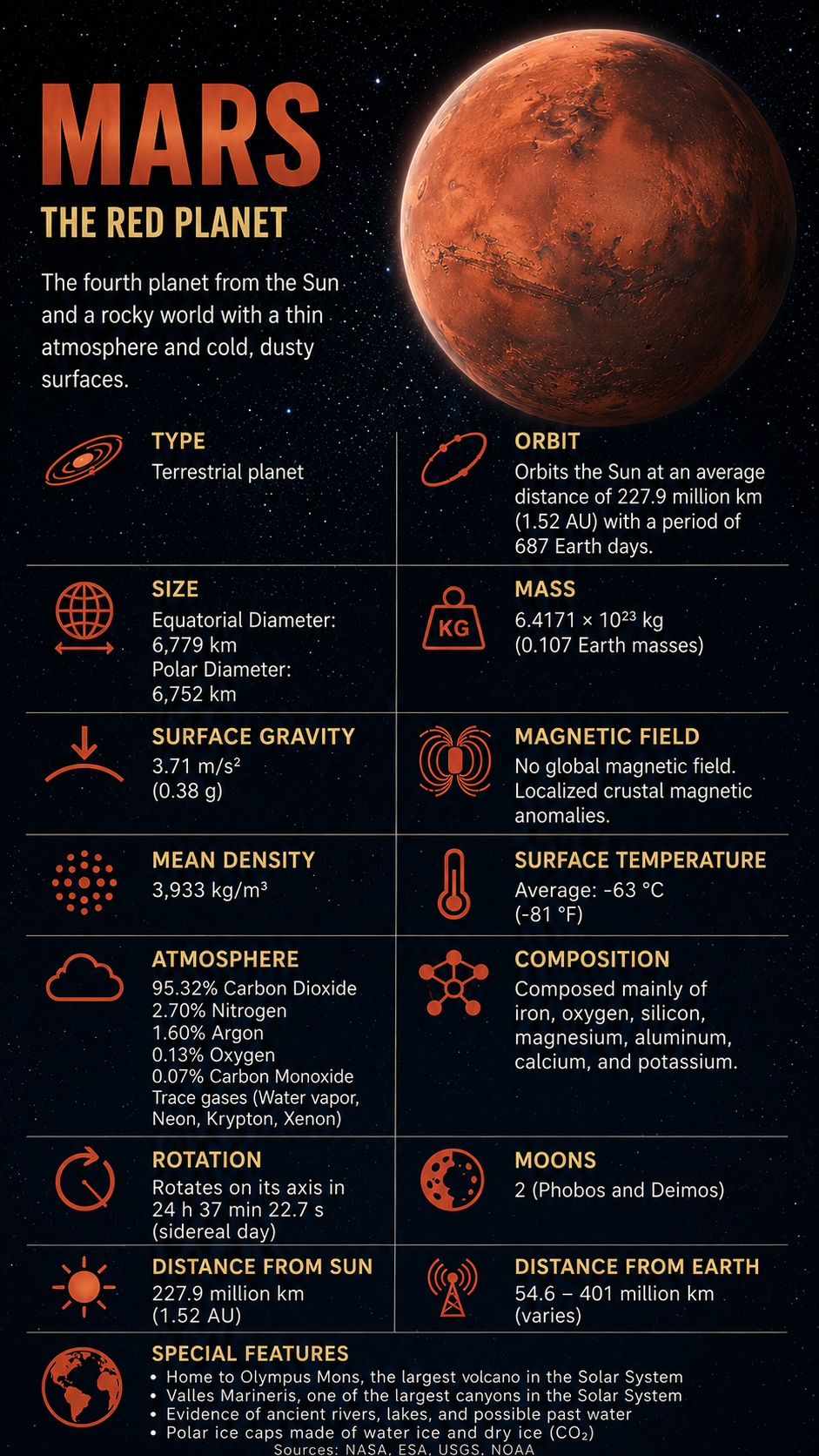
 Mars is often called the “Red Planet” because its surface contains abundant iron oxide minerals, known as rust, which give the planet a reddish appearance when viewed from Earth and from space. The planet possesses a thin atmosphere composed primarily of carbon dioxide, with smaller amounts of nitrogen and argon. Atmosphere pressure at the surface is much lower than on Earth, averaging less than 1% of Earth's sea-level pressure. Because the atmosphere is thin, liquid water is generally unstable on the surface under present Martian conditions.
The surface of Mars contains a wide variety of geological features, including the largest known volcano in the Solar System, Olympus Mons, which rises approximately 22 kilometers (14 miles) above the surrounding plains. The planet also contains Valles Marineris, an immense canyon system stretching roughly 4,000 kilometers (2,500 miles) across the planet, making it one of the largest known canyon systems in the Solar System.
Evidence collected by orbiters, landers, and rovers demonstrates that liquid water existed on Mars in the distant past. Ancient river valleys, lake basins, deltas, sedimentary rocks, and minerals that form in the presence of water indicate that portions of Mars were once wetter than they are today. Water is currently known to exist on Mars primarily as ice, including ice in the polar caps and beneath parts of the surface. The polar regions contain seasonal deposits of carbon dioxide frost as well as substantial water ice reserves.
Mars has two small natural satellites, Phobos and Deimos. Both moons are irregularly shaped and much smaller than Earth's Moon. Their existence and physical characteristics are well established through observation and spacecraft exploration. Mars experiences seasons because its rotational axis is tilted by approximately 25 degrees relative to its orbital plane, a value similar to Earth's axial tilt. As a result, the planet undergoes seasonal changes in temperature, weather patterns, and the extent of its polar ice caps. Dust storms occur frequently on Mars and can sometimes grow large enough to envelop much of the planet.