Breakloose Torque Formula |
||
| \( \tau_p \;=\; P \cdot \dfrac{ \mu \cdot r + p }{ 2 \cdot \pi } \) | ||
| Symbol | English | Metric |
| \( \tau_p \) (Greek symbol tau) = Breakloose Torque | \(lbf-ft\) | \(N-m\) |
| \( P \) = Preeload Force (Axile Force) | \(lbf\) | \(N\) |
| \( \mu \) (Greek symbol mu) = Friction Coefficient between the Threads and Under the Bolt Head/Nut | \(dimensionless\) | \(dimensionless\) |
| \( r \) = Effective Radius of the Thread or Bearing Surface | \(in\) | \(mm\) |
| \( p \) = Thread Pitch | \(in\) | \(mm\) |
| \( \pi \) = Pi | \(3.141 592 653 ...\) | \(3.141 592 653 ...\) |
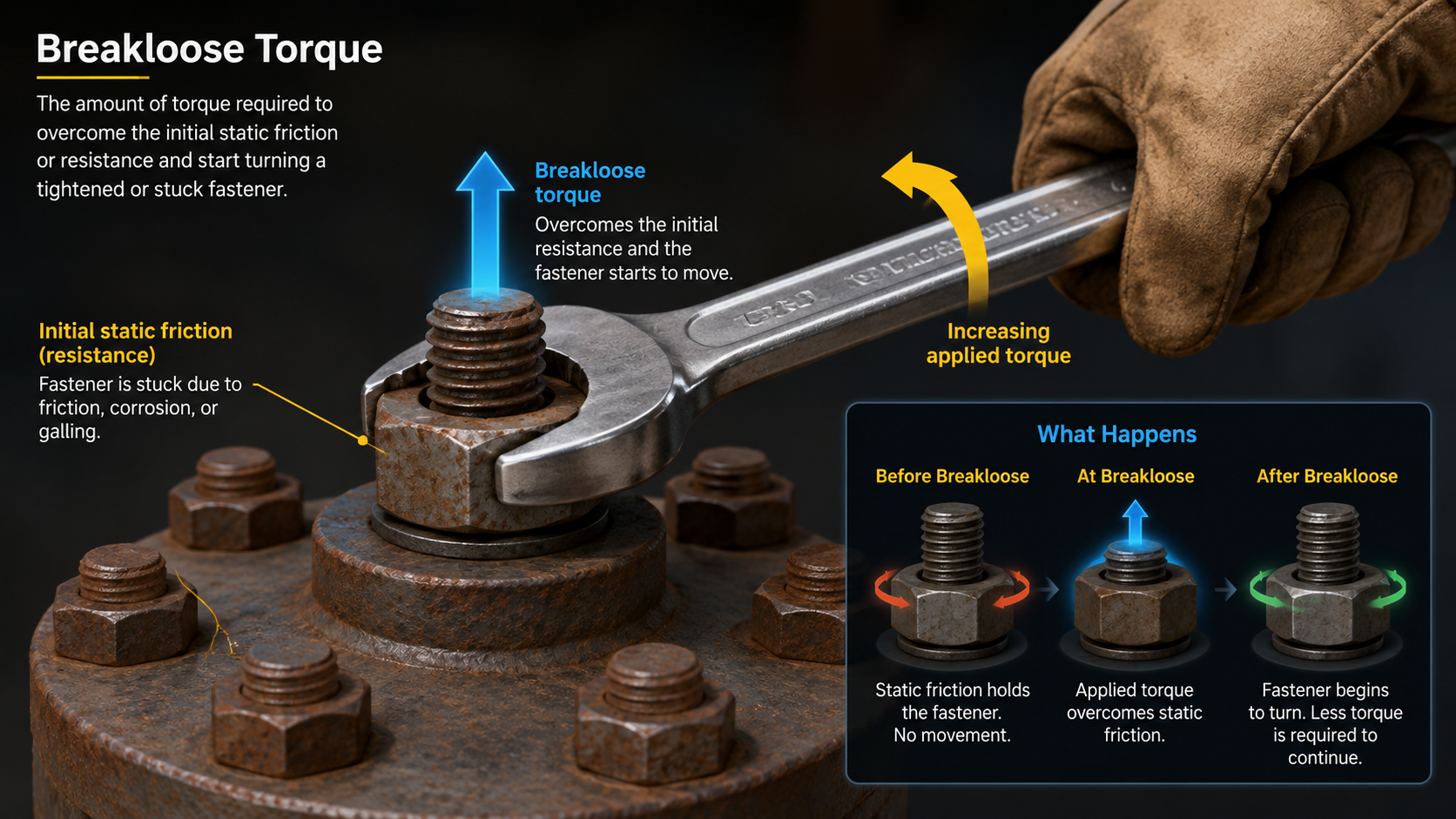
Breakloose torque can depend on various factors, including the type of fastener, the condition of the threads, the lubrication present, and the amount of force applied perpendicular to the fastener. Additionally, factors such as rust, corrosion, or thread damage can increase the breakloose torque required.
It's important to note that once the fastener starts to move, the torque required to continue turning it may be lower than the initial breakloose torque. This is because the friction reduces as the fastener begins to rotate. Breakloose torque is relevant in various industries and applications, such as automotive, machinery maintenance, and construction, where fasteners are commonly used and may need to be loosened or removed for repairs, maintenance, or replacements.