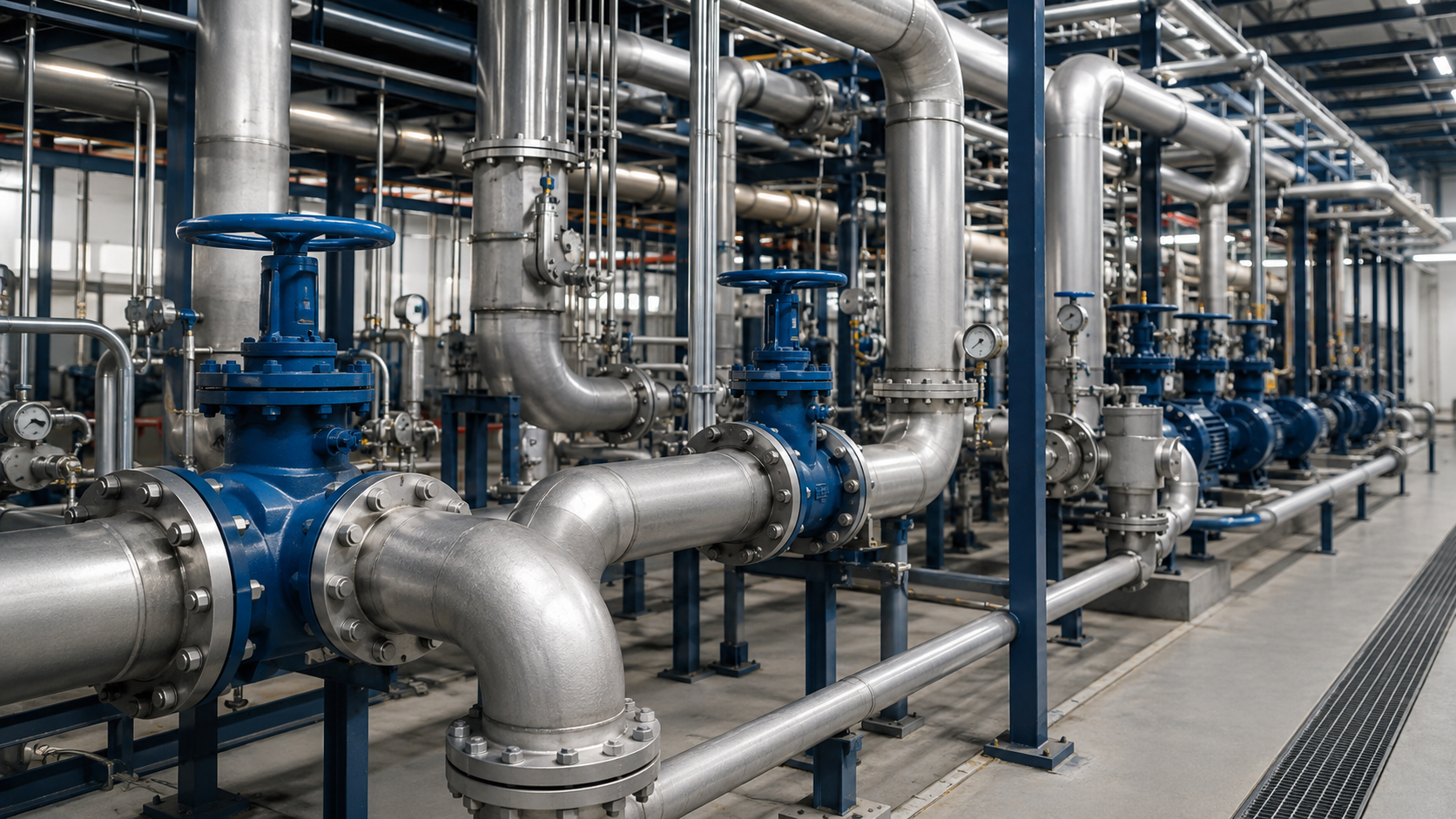
 Piping system is an engineered network of interconnected pipes, components, and equipment designed to convey fluids (liquids or gases) from one location to another within a defined facility or process. It is not limited to the pipes alone, rather it includes all associated elements required to ensure safe, efficient, and controlled fluid transport. These elements typically include valves for flow control and isolation, fittings for directional changes and branching, flanges for detachable connections, gaskets for sealing, supports and hangers for mechanical stability, and instruments for monitoring parameters such as pressure, temperature, and flow rate.
A piping system is designed based on established principles of fluid mechanics, thermodynamics, and material science, with consideration of factors such as pressure, temperature, corrosion, flow characteristics, and external loads. It must comply with recognized codes and standards to ensure structural integrity, leak prevention, and operational safety. The system may serve various functions depending on the application, including process transport in industrial plants, distribution of utilities such as water, steam, or gas, and removal of waste fluids.
Piping System Components
Expansion Joint - Designed to withstand
pressure and
temperatures growth in the piping system. The thermal movement can be angular, axial or lateral. The expansion sometimes must be restricted to a specific length to prevent damage of equipment or piping.
Fastener - A hardware device used to mechanically join or secure two or more components together. Common types include bolts, screws, nuts, and rivets, which create either permanent or removable joints.
Flow Meter - Flow meters are used to measure the rate of fluid flow within the pipeline. They are crucial for monitoring and managing the transportation of liquids or gases.
Gasket - A deformable mechanical component placed between two mating surfaces to create a seal, preventing leakage of fluids or gases under compression.
Instrumentation - arious instruments, such as pressure gauges, temperature sensors, and level indicators, are used for monitoring and controlling pipeline parameters.
Meter - An instrument used to measure and quantify physical quantities such as flow rate, pressure, temperature, or energy consumption in a system.
Orifice Plate - Measures the flow of a
liquid or
gas by the difference in
pressure from the upstream to the downstream. This plate creates a restriction in a
pipe that causes a difference in pressure between the two sides.
Pigging Equipment - Pigs and pigging equipment are used for pipeline cleaning, inspection, and maintenance. This includes pig launchers, receivers, and various types of pigs.
Pipe Fitting - Pipe fittings are components used to connect and join sections of pipe or tubing together. They are used to change the direction of flow, control the
flow rate, or to provide a connection between different types of
pipes or tubing.
Pipe Flange - A bolted connection where two pieces of
pipe, equipment,
fittings or
valves are connected together to form a piping system. Flanges provide access for when equipment (or piping) needs to be cleaned, inspected or reconfigured.
Pipeline Marker - Markers and signage are used for identifying the location, type, and ownership of pipelines, helping prevent accidental damage during excavation.
Pipeline Pigging - A method of cleaning, inspecting, and maintaining pipelines used for transporting
liquids or
gases, such as oil, gas, or water.
Pressure Relief Devices - Pressure relief valves and rupture discs are installed to protect pipelines from overpressure conditions, ensuring the safety of the system.
Scrapers and Cleaning Tools - Additional tools, such as scrapers and brushes, may be used for cleaning purposes during pipeline maintenance.
Spectacle Blind - A safety device used to isolate a section of line or piece of equipment when the line or equipment needs to be inspected or removed from service. It is different than a
valve in that the blind is a permanent or long term isolation device.
Split Tee - A full encirclement split tee is used when hot tapping into a pipeline. It is a pipeline fitting designed such that the inner diameter of the fitting is the same size as the
outside diameter of the pipe that will be hot tapped.
Straightening Vane - Used in pipelines to promote a more uniform and streamlined flow of liquid to straighten the gas flow before going into a gas meter to ensure accurate measurement.
Strainer and Filter - Strainers and filters are installed to remove impurities, debris, or solid particles from the fluid flowing through the pipeline.
Valve - Mechanical devices used to control the flow of
fluids (
liquids or
gases) by opening, closing, or partially obstructing a passage.